
Why We Invested in Octobotics
The Hidden Cost of Keeping Infrastructure Safe
Every industrial asset has a quiet obligation attached to it.
A ship’s hull. A storage tank. A boiler. A wind turbine tower. A bridge.
Everything ages. Steel grows thinner. Welds begin to weaken and develop defects. And every time a ship enters dry dock for inspection, a power plant shuts down for maintenance, or a bridge is closed for structural testing, the cost is inevitable - downtime, lost output, and expensive inspection cycles.
But beyond these visible expenses lies a deeper cost, one that builds quietly over time: accumulating risk.
Industrial infrastructure seldom fails without warning. It degrades slowly - through corrosion, fatigue, overload, and years of stress. And by the time damage becomes visible on the surface, it’s often already advanced. That’s exactly why regulations demand regular inspections.
The paradox is this: the systems built to prevent failure are themselves failing.
Today's industrial inspections still rely almost entirely on human presence. Trained technicians climb scaffolding, rappel down tank walls, navigate confined spaces, and manually test for metal thickness, weld integrity, and corrosion. This approach is:
- Dangerous: In India alone, nearly 6,500 industrial workers died in inspection-related incidents over five years. Globally, the number is far higher. People are being asked to inspect structures that are, by definition, aging and potentially unsafe - often in hazardous environments.
- Economically inefficient: Shutting down a single factory for a few hours for inspection can cost millions per hour in lost production. Ships are taken out of service. Refineries halt operations.
- Inconsistent and error-prone: Human inspectors work in difficult conditions - extreme heat, confined spaces, repetitive tasks over long hours. Fatigue sets in. Vision fails. Small cracks go unnoticed. The very conditions that make inspection necessary make it harder to do well.
The deeper cost isn't just downtime or human error. It's that we're solving a 21st-century infrastructure problem with 20th-century tools. As industrial assets age, as regulatory requirements tighten, and as workforce safety expectations rise, manual inspection is becoming unsustainable.

Why Inspection Can't Keep Scaling Manually
Several structural forces make the current approach untenable:
Assets are aging faster than they're being replaced. Much of the world's critical infrastructure - refineries, bridges, ships - was built decades ago and is now entering the high-maintenance phase of its lifecycle.
Regulations are tightening. Classification societies, railway authorities, and energy regulators are raising inspection standards. The International Maritime Organization (IMO) mandates specific inspection intervals for commercial vessels and Indian Railways (RDSO) enforces strict inspection protocols. These aren't optional - they're legally required.
The cost of failure is rising. A missed defect in a ship's hull can lead to an environmental disaster. A bridge failure can kill dozens. A refinery leak can cause explosions. As the stakes increase, the tolerance for inspection error decreases.
Skilled inspectors are becoming scarce. Industrial NDT (non-destructive testing) requires specialized training. Experienced technicians are aging out of the workforce, and fewer young people are entering the field - especially for roles that involve working at height, in confined spaces, or in extreme conditions.
The biggest opportunity, therefore, is not just to make inspection safer or faster.
It is to fundamentally change how industrial assets are inspected.
Octobotics' Approach:
Imagine a crawler robot no larger than a toolbox that can:
- Magnetically adhere to a vertical ship hull or spherical storage tank
- Navigate curved geometries and cross 90-degree bends
- Perform ultrasonic thickness measurement on heavily corroded surfaces
- Conduct automated weld scanning and corrosion mapping
- Operate wirelessly in hazardous, explosion-risk environments
This is what Octobotics has already deployed in the field, with hundreds of operational hours logged in some of the harshest industrial environments.
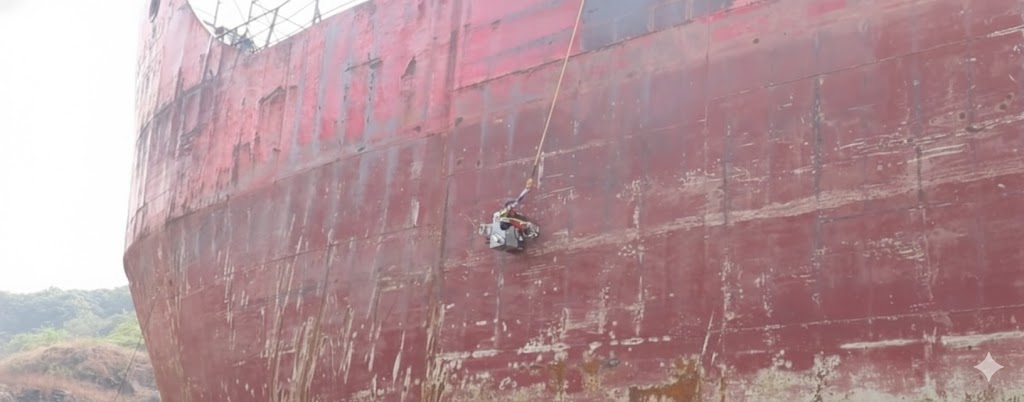
Octobotics is building inspection robots that replace manual, dangerous, non-destructive testing across shipping, oil & gas, power, and heavy industry. The company has developed four flagship products:

What stood out to us was not just the technology, but the evidence that it works in the real world. Octobotics isn't selling prototypes - they're delivering commercial services:
- Repeat customers across industries: L&T Heavy Engineering, Saudi Arabian Chevron, MDM Shipmanagement, Alpha Bulkers, and Indian Oil have all deployed Octobotics' - with various clients repeating orders, which is one of the strongest signals of product-market fit.
- Strategic distribution partnerships: Rather than building a global sales force from scratch, Octobotics has partnered with established NDT service providers - ENTS, Mokshita, Winclex, and Bluestar - who already have relationships with industrial customers and can integrate Octobotics' robots into their service offerings.
- Institutional and regulatory validation: They have received RDSO lab approval from Indian Railways - this has the potential to open up railway track inspection as a vertical, unlocking a significant market opportunity. Additionally, they have received Class NK Approval: Japan's premier classification society endorsement.
Our Conviction: Building Critical Infrastructure from India
Industrial infrastructure doesn't make headlines when it's working - only when it fails. Octobotics is building the systems that prevent those headlines. What excites us about Octobotics is:
Extensive experience in-house: The co-founders, Gulshan Kumar and Ishan Bhatnagar, have spent years as marine engineers working in offshore drilling, dredging, and midstream operations. They know the inspection problem intimately because they lived it. That operational experience translates directly into product decisions: every feature exists because it solves a real problem they encountered in the field.
They've built a defensible moat. Octobotics has been granted over 9 patents covering everything from magnetic crawler design and UAV-mounted manipulators to electromagnetic anchoring systems. These aren't trivial improvements - they're fundamental innovations in how robots navigate complex industrial geometries.
The addressable market is enormous and underserved. The global inspection robotics market is expected to reach $60 billion by 2030, growing at 22% annually. Within that, Octobotics is focused on a $25 billion serviceable market spanning shipping (58,000 ocean-going vessels), bridges (100,000+ in India alone), wind turbines, and oil & gas infrastructure. These assets require inspection by law - it's not a discretionary spend. And as the installed base ages, inspection frequency only increases.
Industrial inspection will always be hard. Physics doesn't negotiate - steel corrodes, welds fail, structures age. But by automating what was once manual and dangerous, the equation changes. Inspections shift from periodic to continuous. Defects are caught before they become catastrophic. And workers stop risking their lives to satisfy regulatory checkboxes.
That's why we invested.

Get a front-row seat to India’s deep-tech innovation
Receive the best of BYT’s analysis and updates, straight to your inbox