
Robotics, Automation & Smart Field Equipment in Indian Agriculture
India can close its mechanization gap while helping farmers produce more with less labor and fewer inputs.
For decades Indian agriculture was defined by small landholdings, heavy reliance on seasonal labor and low levels of mechanization. That picture is now starting to shift. Rural labor is getting scarcer and more expensive. Farmers want higher yields without raising input costs at the same pace. Thus, in this segment, robotics and automation are beginning to move from pilots into the mainstream.
The timing is critical. Mechanization in India is only 40 - 47% compared with more than 90% in developed markets. This gap is both a challenge and an opportunity. Farmers want technology to ease their toughest tasks and policymakers are nudging adoption with subsidies and reforms. Economics, policy and technology are converging to create a market for smart field equipment that barely existed a decade ago.
Why demand is accelerating
Three forces are driving this change:
- Labor economics: Seasonal shortages especially during harvest and spraying push wages higher. Many younger workers are leaving farms altogether.
- Productivity pressure: With limited land, farmers need more from every acre. Precision spraying, guided weeding and timely harvesting make a clear difference.
- Policy momentum: Drone regulations have been simplified. Subsidies for “Kisan Drones” and programs like "NaMo Drone Didi” support adoption through women self-help groups.
Together these forces create both pull from farmers and push from the government.
Where robots are showing up first
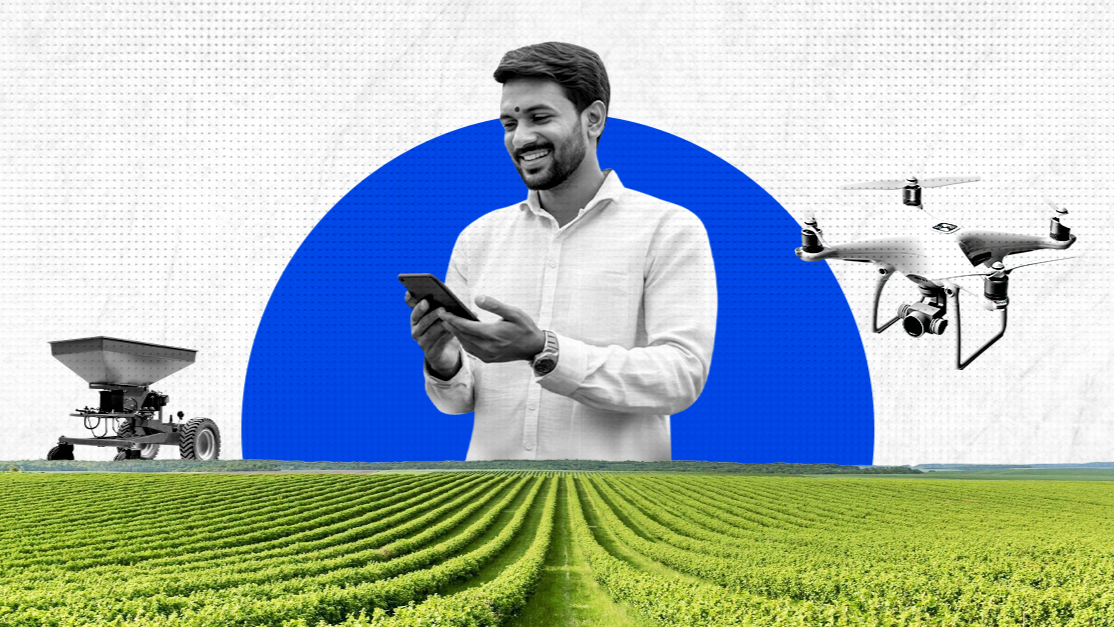
The skies came first. Spraying drones have moved from demo plots into commercial use. Subsidies and training have cut upfront costs and created certified pilots. Farmers now use drones for pesticide application, imaging, insurance assessment and even seed broadcasting.
On the ground, vision-guided sprayers and weeding robots are gaining traction. Companies like Niqo Robotics retrofit machines with AI cameras and actuators so farmers spray only where needed. The benefits include chemical savings, less labor demand and suitability for small fragmented fields. By 2024 Niqo had already covered more than 90,000 acres proving the model.
Autonomous tractors are earlier on the curve but assisted functions like auto-steer and headland turns are spreading. Startups like AutoNxt are layering autonomy onto electric tractors aimed at large farms and custom hiring centers. In parallel, harvest robots are emerging for crops such as cotton. GRoboMac’s multi-arm cotton picker shows how Indian founders are tackling one of the most labor-heavy crops with custom designs.
The Indian context
Global examples inspire but India’s farms pose unique hurdles. Average holdings are about one hectare with irregular shapes, bunds and terraces. Large autonomous platforms are hard to use efficiently. Connectivity and power are weak. Spotty 4G and patchy rural electricity mean robots must work offline, tolerate downtime or rely on local RTK stations and hybrid charging.
Service and maintenance are another constraint. Rural areas lack repair setups for advanced sensors and actuators. Winning models will design modular systems that local tractor mechanics can service and back them with wide support networks. Affordability is also central. Even subsidized drones and robots are costly for smallholders. Adoption often depends on pooled use by FPOs, custom hiring centers or service providers offering robotics-as-a-service.
The model that could work is becoming clear:
- Engineering must be India-proof: able to survive dust, heat, monsoon rains and bright light.
- Unit economics must be service-led with focus on utilization rates, per-acre pricing and reliable uptime.
- Go-to-market should target the most labor-strained jobs first such as cotton weeding and picking, paddy spraying, horticulture and plantations.
Policy fluency matters too. Aligning with subsidy schemes, certification regimes and state procurement programs makes adoption faster. Niqo’s growth, subsidized drone fleets and new cotton-picking prototypes show how early movers are applying this playbook.
What’s next?
This is what we think will happen over the next 5 years:
- Drones will become routine tools for SHGs and FPOs covering millions of acres.
- AI-guided sprayers will expand beyond cotton into oilseeds, pulses and vegetables.
- Assisted autonomy in tractors will spread in larger farms and service centers.
- Selective harvesters will gradually take hold in cotton and high-value horticulture.
The opportunity is significant. India can close its mechanization gap while helping farmers produce more with less labor and fewer inputs. We’re actively funding startups in this space. If you’re building along these lines, we’d love to speak with you.

Get a front-row seat to India’s deep-tech innovation
Receive the best of BYT’s analysis and updates, straight to your inbox