
How AI brings intelligence to modern healthcare
Healthcare is becoming an information science with AI as its computational core.
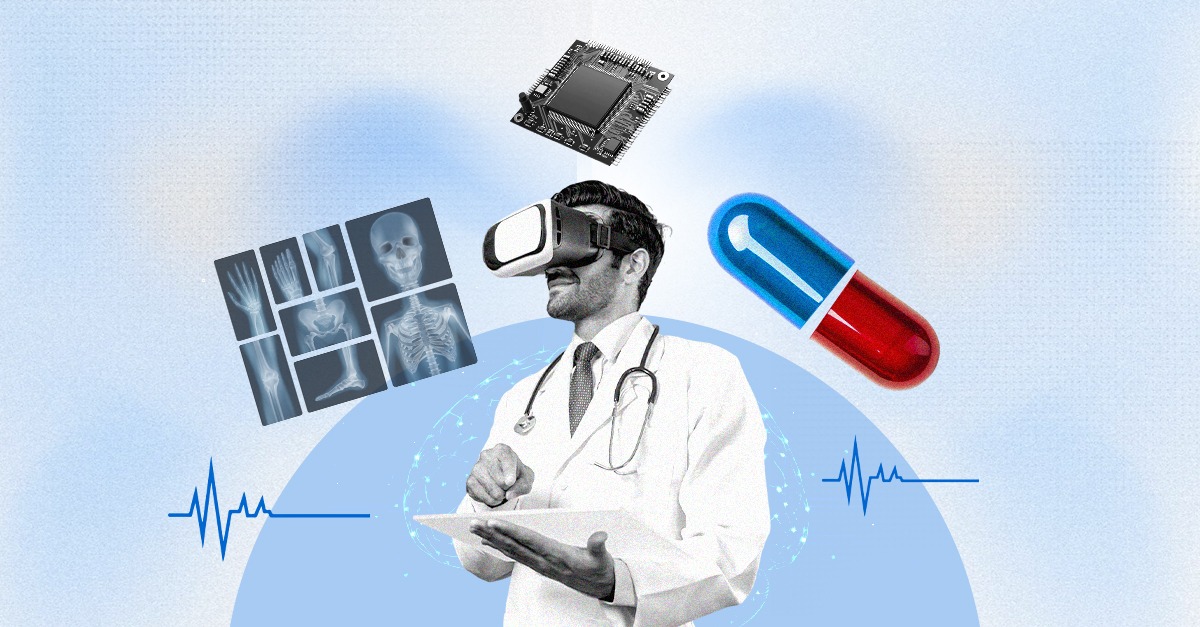
The field of medicine is shifting from intuition to information. As biology, scans and patient records go digital, AI is becoming healthcare’s computational core - learning from data, handling uncertainty and improving.
It’s a shift in how medicine learns, predicts and operates using science, data and computation rather than replacing doctors.
India is well placed to lead this change. The country has deep strength in AI, semiconductors and biosciences. With the Ayushman Bharat Digital Mission already digitising over 110 million health records, India is becoming a test bed for scalable, affordable and context-aware healthcare systems.
Seven shifts that matter
AI is reshaping healthcare layer by layer. Each of these shifts is helping build a smarter, safer and more reliable healthcare system.
1. Building shared intelligence with multimodal models
Healthcare data comes from many places such as genome sequences, scans, lab reports, ECGsand doctors’ notes. Each has a different format and level of detail. Multimodal AI models combine all of these into one system that can reason across them. This gives a more complete and accurate picture of a patient’s health.
Studies show that these models improve diagnostic accuracy but they also face challenges such as missing data or mismatched formats across hospitals. Founders solving these problems will be building the foundation for end-to-end connected healthcare.
Multimodal models are also becoming central to AI-driven drug discovery. By jointly analysing molecular graphs, protein structures and clinical outcome data, generative models can propose new molecules and simulate how they might bind to targets long before they are synthesised in the lab. This “in silico” step dramatically narrows the search space of viable compounds and reduces the cost of early-stage discovery.
2. Hybrid intelligence and digital twins
Prediction alone is never enough in medicine. Doctors also need to understand why a system makes a decision. Hybrid AI models combine known biological rules with neural networks. The result is a patient-specific “digital twin” that simulates how diseases progress or how a treatment might work before it’s tried in real life.
These digital twins allow doctors to test “what-if” scenarios safely. They bring transparency and reliability to complex medical decisions. Building them demands accuracy, explainability and strong regulatory discipline - the hallmark of authentic deep-tech work.
Over time, these digital twins can incorporate genomic data and molecular responses, turning into living models of each patient’s biology. That makes them powerful tools for personalised medicine, where treatment plans are tuned to an individual’s genetics, lifestyle and disease trajectory rather than population averages.
3. Edge and federated systems
Many clinical environments cannot depend on cloud connectivity or external servers. In critical settings like operating rooms or ICUs, AI must work offline and in real time. Edge AI makes this possible by running directly on local machines, reducing delays and improving reliability.
Each hospital trains the model on its own data. Only the learnings are shared, not the data itself. This way, hospitals can work together to improve AI systems without ever exchanging sensitive information. This approach protects privacy and suits India’s diverse and uneven infrastructure.
4. Learning that evolves safely
Medical data is never static. Diseases evolve, imaging equipment upgrades and population patterns shift. Hypothetically speaking, an AI model trained on COVID-19 period scans may struggle to read images from newer machines or detect newer variants unless it keeps learning.
So AI systems built today must evolve with their environment. Continual learning frameworks enable models to detect drift, retrain on new data and sustain performance without being rebuilt from scratch.
Regulators now expect AI systems to adapt safely over time. Treating AI as a living system that learns safely over time ensures reliability and lasting trust.
5. Designing for trust and explainability
For any medical AI to gain adoption, clinicians must be able to understand and question its outputs.
Explainability isn’t something you add later, it’s where you start. Models must show how they reached a conclusion, how confident they are and what data informed that judgment.
Most systems still rely on generic explainers that offer limited insight. The next wave of AI will involve doctors at every step, following feedback loops that build real trust.
6. AI-guided experimentation
AI is now being used to conduct experiments and drive new discoveries. Modern labs use algorithms and robots to design and run experiments automatically. The AI plans, tests and learns, shortening research cycles and improving precision.
This approach speeds up drug discovery, diagnostics and biomarker research. It connects computation and experimentation in a single loop, moving ideas to validation much faster than before.
In drug discovery, deep learning models can generate novel molecular structures, predict their properties and rank them before any wet-lab work begins. Molecular simulation platforms then study how these candidates interact with proteins, cells or tissues at atomic resolution, allowing researchers to discard weak options early and focus resources on high-potential drugs.
Quantum computing adds another layer to this shift. Algorithms such as Grover’s search can, in principle, accelerate the virtual screening of huge chemical libraries by finding promising molecules in far fewer steps than classical search methods. More advanced quantum algorithms for chemistry aim to simulate complex molecular interactions directly, which could one day make it routine to test thousands of drug variants in silico before a single physical experiment is run.
7. Building the rails for healthcare AI
No AI system works in isolation. Healthcare needs reliable infrastructure such as clean data pipelines, standard formats like FHIR (Fast Healthcare Interoperability Resources) and DICOM (Digital Imaging and Communications in Medicine)and tools for tracking safety, biasand performance. This ensures models built in one hospital can safely work in another.
Regulators such as India’s CDSCO (Central Drugs Standard Control Organisation) and the EU MDR (European Union Medical Device Regulation) already require traceable and validated systems. Building compliance into the process from day one saves time, strengthens confidence and keeps innovation continuous.
As AI and genomics come together, these rails must also support secure storage and controlled sharing of genomic data, consent management and audit trails for how genetic insights are used in care decisions. This is critical for scaling personalised medicine in a country as large and diverse as India.
Quantum sensors will gradually plug into this infrastructure as well. By exploiting quantum effects, next-generation sensors promise ultra-sensitive detection of magnetic fields, metabolites or biomarkers, enabling earlier diagnosis of neurological disorders, cancers and metabolic diseases. When their outputs are streamed into AI systems over standardised data rails, clinicians can move from occasional snapshots of health to continuous, high-resolution monitoring.
The Future of Medicine is Smart
India’s diversity of patients, healthcare systems and data makes it a natural lab for healthcare AI. Hospitals such as Apollo are already using AI tools that save doctors several hours a day through automated documentation and analysis.
Healthcare is becoming an information science with AI as its computational core. Precise and personalised insights now emerge from intelligence that processes patient histories, medical images and genomic data to reveal patterns beyond human reach.
In this future, AI-powered genomics helps select the right drug and dose for each individual, while quantum-enhanced simulations and sensors compress discovery timelines and bring earlier, less invasive diagnosis into everyday care. Medicine shifts from reacting to disease to continuously predicting, preventing and personalising it.
Founders building these systems today are laying the foundation for healthcare that learns, remembers and improves with every patient it serves.

Get a front-row seat to India’s deep-tech innovation
Receive the best of BYT’s analysis and updates, straight to your inbox